
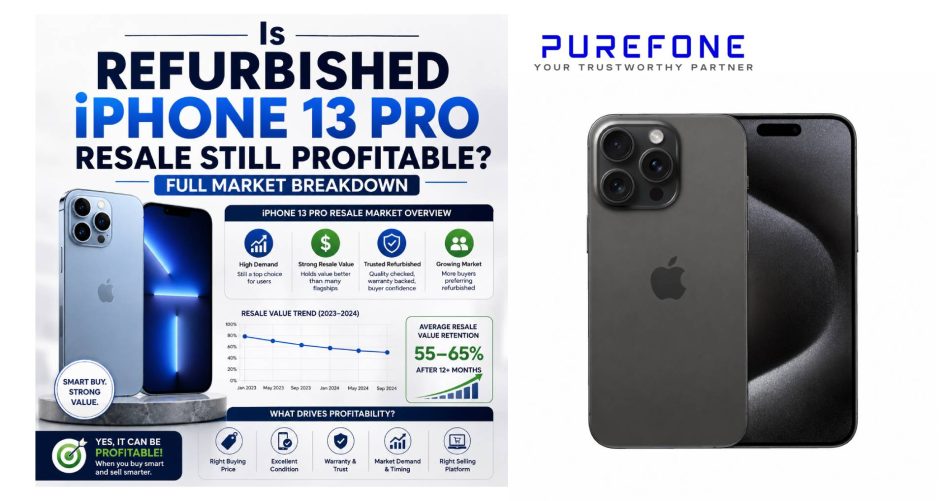
The refurbished iphone 13 pro resale value in the secondary mobile market is undergoing a significant transformation as businesses and consumers alike adjust to economic shifts and sustainability goals. For wholesalers and B2B enterprises, understanding the refurbished iphone 13 pro resale value and the broader lifecycle of premium devices is critical for maintaining healthy margins.
The iPhone 13 Pro, once a flagship powerhouse, now occupies a unique niche in the refurbishment sector, and its refurbished iphone 13 pro resale value continues to prompt a re-evaluation of its profitability. Analyzing current data and future projections reveals that strategic trading of this model still offers substantial opportunities for vendors who closely monitor refurbished iphone 13 pro resale value.
Market dynamics indicate that while the hype around newer models persists, the demand for high-performance legacy devices remains robust. The iPhone 13 Pro continues to be a sought-after commodity due to its premium feature set, which still outperforms many newer mid-range alternatives. This enduring relevance ensures that the refurbished iphone 13 pro resale value stays resilient, even as the device ages. Businesses that can accurately assess the condition and market positioning of these units stand to gain significant competitive advantages.
Wholesalers must recognize that profitability is no longer just about acquiring stock at the lowest price but also about optimizing the sales cycle and presentation. The differentiation between a used device and a professionally refurbished unit has become a key value driver in the B2B space. By focusing on quality assurance and transparent grading, sellers can command higher prices and foster long-term trust with enterprise buyers. Consequently, the decision to buy and sell refurbished iphone 13 pro inventory requires a nuanced approach that balances acquisition costs with refurbishment investment.
1. Why Is the Refurbished iPhone 13 Pro Resale Value Defying Market Expectations?
The sustained performance of the iPhone 13 Pro in the secondary market defies typical depreciation curves often seen in consumer electronics. Several factors contribute to this anomaly, primarily centered on the device’s hardware longevity and the specific needs of the B2B procurement sector. Unlike standard consumer models that lose appeal rapidly, the Pro series retains utility due to advanced camera systems and processing power that remain relevant years after release. This creates a stable demand floor that supports the refurbished iphone 13 pro resale value even amid fluctuating market conditions.
Economic prudence is a major driver for businesses opting for the iPhone 13 Pro over newer iterations, and the refurbished iphone 13 pro resale value plays a key role in this decision. With corporate budgets tightening, procurement managers are increasingly looking for devices that offer enterprise-grade capabilities without the premium price tag of the latest releases, which directly influences the refurbished iphone 13 pro resale value in bulk markets. The iPhone 13 Pro fits this requirement perfectly, offering 5G connectivity, A15 Bionic chip performance, and a high-quality display suitable for professional use, further strengthening the refurbished iphone 13 pro resale value across B2B procurement channels.
Furthermore, the supply chain for newer models has faced intermittent disruptions, whereas the parts and repair ecosystem for the iPhone 13 Pro is mature and cost-effective. For refurbishers, this means lower overhead costs and higher yield rates during the restoration process. The availability of high-quality aftermarket parts allows vendors to restore units to a like-new condition efficiently, thereby maximizing the potential resale price. This maturity in the supply chain acts as a buffer, protecting the profitability margins for wholesalers who specialize in this specific model.
Customization also plays a pivotal role in maintaining value. B2B clients often require specific configurations, such as increased storage capacity or particular carrier unlocks, which are readily available in the iPhone 13 Pro market. The ability to provide tailored batches of devices that meet exact corporate specifications adds a premium to the stock. Consequently, the iphone 13 pro refurbished resale price remains buoyant because the device can be effectively adapted to meet diverse business needs, a flexibility that newer, more locked-down supply chains sometimes struggle to match immediately.
1.1 How Does Performance Longevity Impact Sustained Pricing?
The A15 Bionic chip remains a formidable piece of silicon that effortlessly handles the vast majority of business applications and productivity suites available today. Performance benchmarks from 2025 indicate that the chip’s efficiency is comparable to many mid-range processors currently being manufactured in new devices. For wholesale buyers, this means that purchasing iPhone 13 Pro stock does not entail a compromise on operational speed or multitasking capabilities. The device’s ability to run current iOS versions smoothly ensures that its functional lifespan extends well beyond the typical three-year corporate refresh cycle.
Software support from Apple further cements the longevity of the device, guaranteeing security updates and feature parity for several more years. Businesses are particularly sensitive to security compliance, and the assurance that the iPhone 13 Pro will remain secure until at least 2026 makes it a safe investment. This projected software longevity directly correlates to the device’s retained value, as buyers are willing to pay more for hardware that promises a longer utility window. The refurbished iphone 13 pro resale value benefits significantly from this extended support cycle, reducing the risk of obsolescence for inventory holders.
In the wholesale sector, the consensus is that performance longevity dictates the liquidity of the asset. Devices that lag or struggle with modern interfaces see quicker price erosion, whereas the iPhone 13 Pro continues to perform admirably. This reliability allows refurbishers to market these units not just as cost-effective alternatives, but as high-performance tools ready for immediate deployment. The narrative shifts from buying “old technology” to acquiring “proven technology,” which is a compelling selling point that sustains pricing power in B2B negotiations.
1.2 Which Economic Factors Are Driving Demand for Older Pro Models?
Global economic uncertainty has prompted a widespread re-evaluation of capital expenditure within enterprises, leading to a surge in demand for refurbished technology. Companies are prioritizing OpEx efficiency, seeking to equip their workforce with reliable hardware without the hefty depreciation hit associated with new flagship devices. The iPhone 13 Pro serves as an optimal solution in this scenario, offering premium features at a fraction of the original cost. This macroeconomic trend acts as a powerful propellant for the market, ensuring that the drive to buy and sell refurbished iphone 13 pro units remains a profitable venture.
Inflationary pressures have also altered the purchasing power of consumers and small businesses, expanding the total addressable market for refurbished electronics. As the price of new devices escalates, the “good enough” threshold shifts, making high-spec older models like the iPhone 13 Pro the new standard for smart buyers. This phenomenon is particularly pronounced in developing markets where new iPhones are prohibitively expensive, creating a robust export opportunity for wholesalers. The interplay between rising new device costs and the stagnation of wages in various sectors fuels a continuous pipeline of demand for affordable Pro-level hardware.
Furthermore, the emphasis on Corporate Social Responsibility (CSR) and sustainability has incentivized many corporations to opt for refurbished devices to reduce their carbon footprint. Choosing a refurbished iPhone 13 Pro over a new model aligns with ESG (Environmental, Social, and Governance) goals, providing a dual benefit of cost savings and sustainability branding. This ethical dimension adds another layer of demand insulation, protecting the market from purely cyclical economic downturns. As more companies commit to circular economy principles, the market for high-quality refurbished Pro models is structurally supported beyond mere cost considerations.
2. How Can Businesses Maximize the iPhone 13 Pro Refurbished Resale Price?
Maximizing returns on iPhone 13 Pro inventory requires a rigorous adherence to quality control and grading standards that signal value to potential buyers. Wholesalers must implement comprehensive testing protocols that go beyond basic functionality checks, encompassing battery health percentage, cosmetic perfection, and component authenticity. A device graded as “Premium” or “Mint” can command a significantly higher iphone 13 pro refurbished resale price compared to a standard “Good” unit, often offsetting the cost of the additional labor required to bring it to that standard. This focus on differentiation is essential for standing out in a crowded wholesale marketplace.
Strategic refurbishment involves identifying high-impact areas where investment yields the highest return. For the iPhone 13 Pro, replacing a worn battery with a genuine high-capacity unit and swapping out scratched chassis components can drastically alter the perceived value. Buyers in the B2B space are less tolerant of cosmetic defects when purchasing premium tier devices, expecting a pristine appearance despite the pre-owned status. By meticulously addressing these aesthetic and functional wear points, sellers can position their stock at the top of the pricing bracket, ensuring faster turnover and better margins.
Effective marketing of refurbished stock also plays a crucial role in maximizing price. Listings and B2B proposals should highlight the specific refurbishment processes undertaken, such as “90%+ battery health,” “original OEM screen replacement,” or “full sanitization.” Transparency regarding the refurbishment journey builds trust and justifies a premium price point. When buyers understand the rigor involved in restoring the device, the perceived risk drops, and their willingness to pay closer to the top of the market range increases. This narrative of quality restoration is key to capturing the full value of the inventory.
2.1 Why Is Inventory Management Crucial for Profit Margins?
In the fast-paced mobile electronics sector, the speed of inventory turnover is inextricably linked to profitability. Holding onto stock of the iPhone 13 Pro for too long exposes the business to the risk of further depreciation and tied-up capital. Savvy wholesalers utilize real-time market data to adjust pricing dynamically, ensuring that inventory moves before the next model announcement or market shift erodes its value. Efficient inventory management systems that track the age and status of each unit allow businesses to make data-driven decisions about when to hold for a better price or when to liquidate to preserve capital.
Customization and bundling strategies can also enhance inventory velocity. By grouping iPhone 13 Pro units with compatible accessories, such as magnetic cases or fast-charging bricks, wholesalers can create value-added packages that are easier to sell at a premium. This approach not only increases the average transaction value but also helps clear out older accessory stock. For B2B clients, these ready-to-deploy kits offer convenience and immediate utility, making them a more attractive proposition than buying devices and accessories separately. Consequently, effective bundling can accelerate sales cycles and protect margins against market price drops.
Forecasting demand based on seasonal trends is another critical aspect of inventory management. The back-to-school season and holiday periods typically see spikes in demand for mobile devices, including refurbished models. Aligning stock acquisition and refurbishment schedules to peak ahead of these cycles ensures that businesses are fully stocked when demand is highest, thereby maximizing the refurbished iphone 13 pro resale value. Conversely, understanding market lulls allows businesses to scale back procurement efforts, avoiding the accumulation of stagnant inventory that would eventually require deep discounting to move.
2.2 Which Customization Options Add the Most Value?
Customization in the wholesale refurbished market is a powerful differentiator that allows vendors to cater to specific B2B client needs. One high-value customization is the pre-configuration of devices with enterprise-specific software or MDM (Mobile Device Management) profiles. For large corporate clients, receiving iPhone 13 Pro units that are already imaged with the necessary operating systems and security protocols saves significant internal IT resources. This service transforms the product from a mere commodity into a bespoke business solution, justifying a higher price point and fostering deeper client relationships.
Laser engraving and branding services offer another avenue for value addition, particularly for promotional companies or organizations looking to distribute devices. The ability to apply a corporate logo or employee identification directly onto the chassis or glass of the iPhone 13 Pro adds a layer of exclusivity and security. While this customization requires specialized equipment, it opens the door to niche B2B markets that standard wholesale channels cannot serve. By offering these personalized touches, refurbishers can escape the race-to-the-bottom pricing often found in generic commodity markets.

Storage and color consolidation are also vital customization strategies for wholesale buyers. Many enterprises prefer uniformity in their device fleets, requiring 50 units of the same color and storage capacity rather than a mixed assortment. Refurbishers who can aggregate inventory and provide homogeneous batches of iPhone 13 Pro models—such as all 256GB Graphite units—provide immense value to procurement managers. This consolidation saves the buyer time and effort in sorting and configuring stock, making the customized batch more valuable than the sum of its individual parts.
3. Why Should You Buy and Sell Refurbished iPhone 13 Pro Units in 2025?
Entering the market to buy and sell refurbished iphone 13 pro units in 2025 is a strategic move supported by favorable supply and demand economics. The supply of trade-in units has reached a volume that stabilizes acquisition costs, while the demand for cost-effective premium devices remains high. This equilibrium creates a predictable trading environment where margins can be calculated with reasonable accuracy. For businesses looking to establish or expand their foothold in the mobile resale sector, the iPhone 13 Pro represents a low-risk, high-liquidity asset class that is easy to move in both domestic and export markets.
The maturation of the refurbishment supply chain means that parts are readily available and comparatively affordable, reducing the barrier to entry for new repair shops. Unlike newer models which may have proprietary parts restrictions or limited availability, the iPhone 13 Pro enjoys a healthy ecosystem of OEM and high-quality aftermarket components. This accessibility ensures that refurbishment costs remain manageable, allowing sellers to maintain healthy profit margins even if they need to invest in repairs. The ability to cost-effectively restore damaged units to working condition significantly expands the pool of purchasable inventory, increasing the potential for profit.
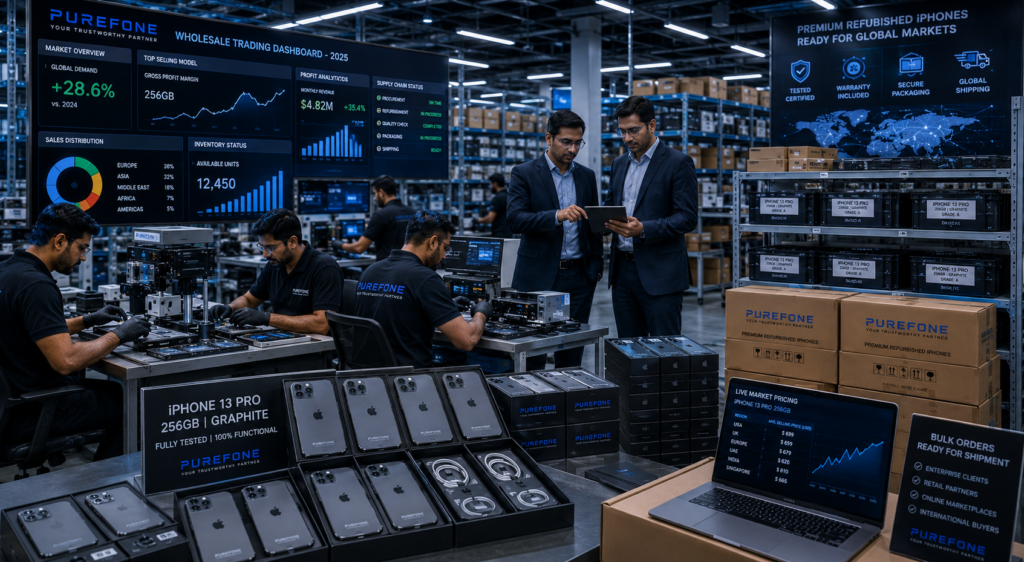
Moreover, the iPhone 13 Pro is poised to become the “sweet spot” device for the next 12 to 18 months as it bridges the gap between budget options and ultra-premium new releases. It offers a feature set—ProMotion display, triple-camera system, and premium build—that newer entry-level phones simply cannot match. positioning the device as the smart choice for value-conscious professionals. Capitalizing on this positioning allows sellers to market the device aggressively, emphasizing the superior user experience relative to its price point. This compelling value proposition makes active trading of this model a highly profitable endeavor for the foreseeable future.
3.1 How Does the 2026 Market Outlook Influence Current Strategy?
Looking ahead to 2026, market analysts predict a shift in the secondary market driven by the anticipated phase-out of LTE-only networks in several regions, accelerating 5G adoption. The iPhone 13 Pro, being fully 5G capable, is well-positioned to remain relevant as this infrastructure transition progresses. Businesses that accumulate stock now can leverage this future-proofing aspect, marketing the devices as compliant with next-generation network standards. This foresight allows sellers to future-proof their inventory, ensuring that the refurbished iphone 13 pro resale value does not plummet prematurely due to technological redundancy.
Industry forecasts also suggest that by 2026, the refurbished market will account for a significantly larger share of total smartphone sales, potentially eclipsing new phone sales in certain demographics. This structural shift in consumer behavior implies that the demand for established models like the iPhone 13 Pro will broaden rather than shrink. Wholesalers who build strong supply chains and reputations for quality now will be best positioned to capture this expanding market share. The strategy should therefore focus on volume aggregation and brand building to secure a leading position as the market tilts further in favor of refurbished goods.
However, the 2026 outlook also suggests a potential narrowing of price margins between older Pro models and newer non-Pro models as technology trickles down. To mitigate this, current strategies must focus on rapid turnover and vertical integration, where possible. Sellers should aim to control more of the value chain, from sourcing to refurbishment to direct sales, cutting out middlemen to preserve margins. By preparing for a more competitive, volume-driven future in 2026, businesses can make calculated investments in iPhone 13 Pro inventory today that will pay dividends as the market matures.
3.2 Which Wholesale Channels Offer the Best ROI?
Identifying the most profitable sales channels is paramount for maximizing the return on investment when trading iPhone 13 Pro units. Direct B2B sales to enterprise clients often yield the highest margins per unit, as these transactions involve bulk volumes and lower customer acquisition costs. Establishing partnerships with device leasing companies and large-scale fleet managers creates a reliable revenue stream that bypasses the fees and competition of public marketplaces. These direct relationships allow for negotiated pricing models that can be adjusted based on volume, ensuring steady profitability throughout the year.
Online B2B wholesale platforms provide a broad reach and access to international buyers, which is crucial for maintaining high inventory velocity. These platforms offer the advantage of liquidity, allowing sellers to move large quantities of iPhone 13 Pro stock quickly. While margins per unit might be slightly lower due to platform fees and competition, the sheer volume potential compensates for the reduced per-unit profit. Optimizing listings for these platforms with high-quality images and detailed specifications is essential to attract serious international buyers looking for reliable stock.
Export markets, particularly in regions with developing economies, present a massive opportunity for high-volume sales. In many of these markets, the iPhone 13 Pro is still viewed as a status symbol and a top-tier device, allowing sellers to command prices that are sometimes higher than in domestic saturated markets. Navigating the logistics and regulatory requirements of export can be complex, but the financial rewards are often substantial. Diversifying sales channels to include a mix of domestic bulk sales, online platforms, and international exports ensures that a business is not overly reliant on a single revenue stream, thereby optimizing overall ROI.
Conclusion
The iPhone 13 Pro continues to offer a compelling business case for wholesalers and refurbishers as we move through 2025 and into 2026. Its potent combination of hardware longevity, sustained software support, and enterprise appeal ensures that its market value remains robust. By focusing on quality refurbishment, strategic inventory management, and B2B-focused customization, businesses can maximize the refurbished iphone 13 pro resale value effectively. The market dynamics favor prepared sellers who can source, restore, and distribute these devices efficiently to a growing base of cost-conscious and sustainability-minded buyers.
Frequently Asked Questions
1. Is the refurbished iPhone 13 Pro resale value still profitable in 2025?
Yes, the refurbished iphone 13 pro resale value remains highly profitable due to a confluence of sustained demand and mature supply chains. The device offers premium features like the A15 Bionic chip and ProMotion display that still outperform many newer mid-range models. For wholesalers, this creates a “sweet spot” where acquisition costs are manageable, but resale prices remain robust, especially when targeting B2B buyers seeking enterprise-grade performance without flagship pricing.
2. How does the iPhone 13 Pro refurbished resale price compare to newer models?
The iphone 13 pro refurbished resale price typically offers a better value proposition for budget-conscious businesses than buying newer base models. While newer models may have minor incremental upgrades, the iPhone 13 Pro retains the “Pro” features—such as the triple-camera system and high-end build quality—that are often missing in cheaper, newer alternatives. This allows sellers to position the 13 Pro as a superior device at a competitive price point, maintaining strong margins.
3. Why should businesses buy and sell refurbished iPhone 13 Pro units now?
Businesses should buy and sell refurbished iphone 13 pro units now because the market is approaching an equilibrium of stable supply and high demand. With economic pressures driving enterprises toward cost-effective tech refreshes, the 13 Pro is a top contender for bulk procurement. Additionally, the refurbishment ecosystem for this model is at its peak, meaning parts are cheap and repairs are efficient, maximizing the potential return on investment for resellers.
4. Which factors most influence the profitability of reselling iPhone 13 Pro stock?
The primary factors influencing profitability include the device’s condition grading, battery health, and storage capacity. Units with battery health above 90% and pristine cosmetic condition (Grade A+) command significantly higher prices. Furthermore, the ability to provide customized configurations, such as specific storage sizes or carrier unlocks, allows wholesalers to tap into niche B2B markets willing to pay a premium for tailored inventory.
5. How can wholesalers maximize their margins on iPhone 13 Pro inventory?
Wholesalers can maximize margins by investing in high-quality refurbishment processes that ensure devices look and function like new. Implementing strict quality control and offering value-added services—such as custom laser engraving, MDM configuration, or enterprise accessories—differentiates their stock. These additions justify a higher iphone 13 pro refurbished resale price and accelerate turnover by appealing directly to corporate buyers’ needs for convenience and reliability.
6. What is the 2026 market outlook for the iPhone 13 Pro?
The 2026 market outlook remains positive as global 5G infrastructure rollouts complete, making the 5G-capable iPhone 13 Pro a future-proof asset for emerging markets. While newer models will release, the 13 Pro is expected to remain a staple in the secondary market due to its robust performance. Forecasters suggest that demand for legacy Pro models will remain steady, provided that iOS support continues, making it a safe inventory hold for the next 12-18 months.
7. Why is inventory management critical when trading iPhone 13 Pro devices?
Inventory management is critical because the refurbished iphone 13 pro resale value can be affected by rapid market shifts and the release of newer competitors. Holding onto stock for too long increases storage costs and risks depreciation. Successful wholesalers utilize dynamic pricing strategies and seasonal trends—such as back-to-school or holiday periods—to move stock quickly, ensuring cash flow remains healthy and inventory does not become obsolete.
8. Which customization options add the most value for B2B clients?
For B2B clients, the most valuable customization options include pre-loading enterprise software (MDM profiles), laser engraving for asset tracking, and creating uniform asset tags. Custom accessories bundles, such as including rugged cases or charging stations, also add significant value. These tailored solutions transform a standard device into a ready-to-use business tool, allowing sellers to command higher prices and build long-term corporate contracts.
9. How does battery health affect the ability to sell refurbished iPhone 13 Pro units?
Battery health is a decisive factor for buyers, as it directly impacts the device’s usability and longevity. Units with batteries below 80% health often require immediate replacement, which eats into profit margins. To buy and sell refurbished iphone 13 pro units successfully, refurbishers should prioritize replacing batteries with high-capacity OEM equivalents, ensuring the device displays peak performance metrics that justify a premium “Refurbished Excellent” grading.
10. Are export markets profitable for iPhone 13 Pro wholesalers?
Yes, export markets are highly profitable, particularly in developing regions where new iPhones are prohibitively expensive. The iPhone 13 Pro is often viewed as a status symbol in these markets, and its 5G capabilities make it a future-proof choice. By navigating international logistics and regulations, wholesalers can often secure higher prices per unit in export markets compared to saturated domestic markets, significantly boosting overall profitability.


